REVIEWS -- Assassin's Creed: Director's Cut Edition -- PC

Assassin

EDITOR AVERAGE

89

USER AVG

--

Ubisoft Montreal delivers another classic with Assassin’s Creed

by Eric Silva


Fun factor: Fun

Worth to: Buy/Rent

You will stab your way across medieval cities in a tale fit for a Hollywood blockbuster, and you will curse Ubisoft for not making this game perfect!

Ubisoft Montreal is on a roll with games depicting nimble, Middle Eastern characters. Prince of Persia had you climbing walls and jumping cat-like through everything but flaming hoops, now Assassin’s Creed expands on it in a more mature, action-oriented way, and does so with deadly style. Slaying opponents should never bring as much pleasure as it does in Creed. The mere fact mainstream media have been focusing on Grand Theft Auto 4 and Mass Effect over their graphic nature is a sign of how out of touch and ignorant they are. This “killer” title will leave many with a sick, gratifying smile on their face.

The game is not without flaws but as a whole Ubisoft’s title delivers on its goal: to make us believe we are a Hashshashin in medieval times. The flaws, though few, hurt. Not because they make enjoying the game impossible, but because you wish Assassin’s Creed was perfect. The game will become a fan favorite for many and you can be sure sequels will follow - guaranteed.

My name is “The Flying One, Son of No One”

That settles it: I will call my firstborn son Altaïr. None of the kids will ever dare picking on him, especially when his middle name is Son of No One and he carries a retractable wrist-blade. Few games manage to make you want to be the protagonist in such an effective way. The main character, Altaïr ibn La-Ahad, is a bad-ass assassin. Assassins are usually bad, but this one is extra-bad. Badness oozes from every move, every sword swing and every life he snuffs. Altaïr even looks bad when he climbs walls, loses balance or is thrown to the ground. He makes Agent 47 look like an American Idol contestant. That said, Assassin’s Creed does a remarkable job bringing the main character to life.

The game begins with Altaïr about to complete an important mission. Being the hothead that he is, he takes his target head on with dire consequences. Al Mualim, his master, punishes Altaïr and strips him of his rank, forcing “The Flying One” to regain his honor and the true meaning of the assassin’s creed by killing nine targets spread out across the Kingdom. From Templar knights to Muslim leaders, you off each pray like a white-hooded panther. As the story unfolds you regain your former glory. Your loyalty is put to the test each time you complete an assassination until the past and present come together unraveling a secret that could bring colossal changes to the world.

The story is somewhat muddled at first, mixing two eras with a hard-to-swallow concept, but once things pick up you are glad of the direction. Events are told through the memories of a present-day young man called Desmond Miles who was captured by a group of scientists working for the Abstergo corporation (geez, couldn’t you have come up with something that doesn’t sound like anti-diarrhea medication?). The memories are brought back from the past with the help of a machine called the Animus (that’s better) - a contraption designed to record memories encoded in our DNA. Desmond lies on a metallic table and goes back in time, reliving what his ancestor saw. Soon, he finds that all is not as it seems.

This is why games are better than movies...

Kudos to the guys at Ubisoft for taking the time to research real locations and characters and showing the beauty in cultural diversity. If anything, Ubisoft Montreal is a studio that tries to heal the wounds created by mass media racial stereotypes.

Creed accurately recounts the last events of the Third Crusade when Saladin and King Richard fought over control of the Holy Land, referred to as “The Kingdom”. All nine targets (or “marks”, for all you non-assassin types) were indeed real historical figures. Robert de Sablé, your main target, was Grand Master of the Templars from 1191 to 1193. But don’t count on the game helping you with your SATs; it takes a few liberties rewriting history.

Players do stand to at least gain a sense of how life looked and sounded back then. You truly will go back in time and relive the Dark Age, and you will thank the Animus for giving the entire process a kind of scientific objectivity.

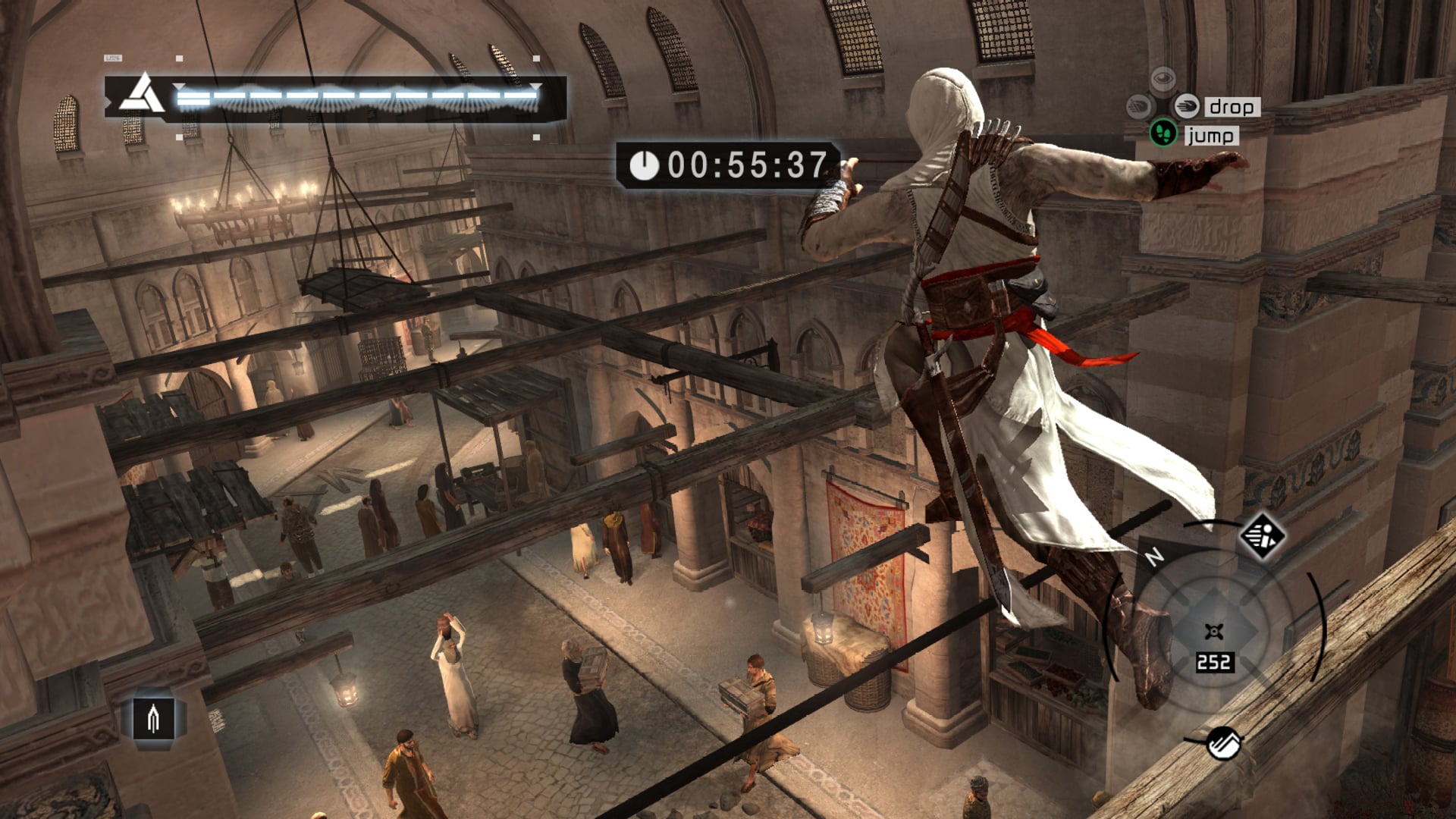
Assassin’s Creed isn’t the most innovative game in terms of graphics, and thankfully so. A dual-core with a two-year old graphics card will be enough to enjoy the game without losing any of the glitter. The glitter itself is in the historical accuracy of the levels. Markets are full of people, gardens are lush and streets are busy and dirty. You can hear Arabic, German, English and French languages spoken on the streets. People go about daily activities as one would imagine life in the 12th century. Women carry pots on their heads, town criers spout propaganda, beggars harass passersby and war, as well as religion, is in the air. Graphical extras like cloud cast and cotton spores in the air, perfect animation, astounding city details and amazing sound effects harmonize the whole package into an experience you won’t find in most movies.

Architecture is loaded with details, and rightfully so - you will be getting a good glimpse of it each time you climb any surface. One complaint is that environments are repetitive. Creed effectively has only two types of cities: European and Middle Eastern. You cannot, for instance, distinguish the difference between Damascus and Jerusalem. Each city has the same markets, towers, churches and mosques. This quickly becomes a forgettable nuisance once you become engrossed in the gameplay.

Travel is done by horse through the various landscapes. This lets players further enjoy the game’s ambitious level designs. As the game progresses you are given the option to jump directly to any city you desire. I personally have found myself taking the long route only to experience the visuals and exquisite music.

The soundtrack is a masterpiece, rivaling Harry Gregson-Williams’ work in the Kingdom of Heaven. Beautiful, thematic scores literally bring the era to life. The score fuses itself to the game’s rich environments. British Academy Award winner, Jesper Kyd, did a phenomenal job...

A living tapestry of sound and fury.

Controls are somewhat complicated at first, forcing you to utilize multiple buttons at the same time to perform the simplest of tasks, but once you get used to them you wouldn't want them any other way. Most of the fights are action-oriented leaving Altaïr outnumbered and doing lots of counter kills. A counter kill is performed when the player presses a button at the right time. The result lets Altaïr lose on his opponent in a series of well-animated moves. Though you will often rely on counter kills to win your battles, Assassin’s Creed forces players to master all forms of combat, including stealth kills and knife throwing.

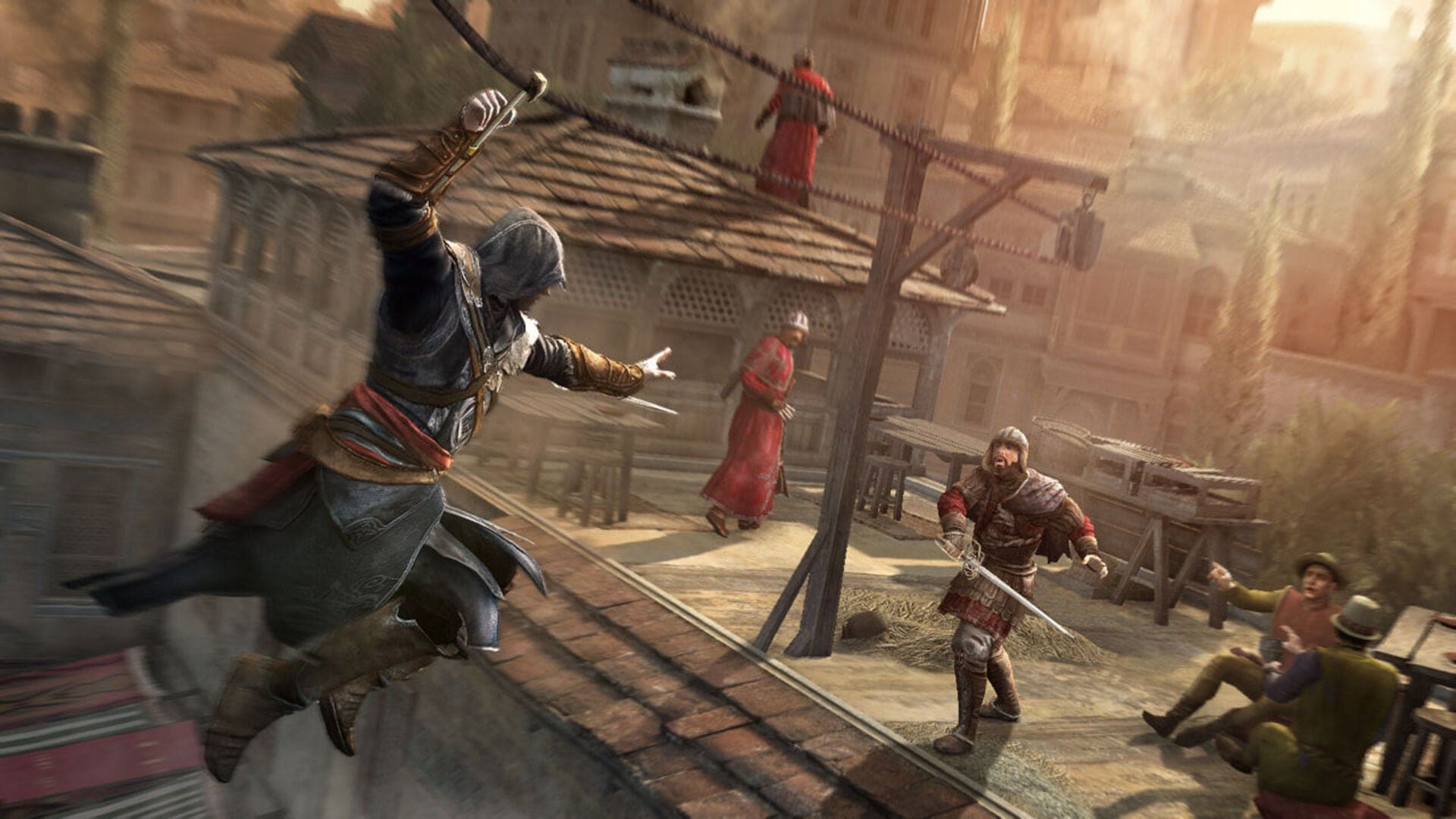
Stealth kills are stunning and perfectly executed. Once the wrist-blade is selected, the option to assassinate a character becomes available when you are within striking distance. The deed done, you simply walk away while your victim staggers about holding their fatal wound before collapsing. Stealth kills can also be performed while running. If a kill is executed before reaching the victim Altaïr will leap onto his victim and impale him with his wrist-blade in full public view. Doing so can get you in trouble, though.

A “low profile” feature lets you detract attention when someone is suspicious of you. Unfortunately, the feature isn’t perfect. It can lead to strange scenarios. After killing a group of soldiers, stupid guards will still ask “Who did this?!” You being the only calm one amidst screaming citizens and dozens of dead bodies should tip them off, but “low profile” has that covered… You can even “low profile” while on horseback. Here, again, we have some problems. You will be forced to use the feature often, and each time you do the horse slows down to a dreadful crawl. A guy riding like a snail through a large open area was apparently not suspicious to guards back then.

Much of the game is played while investigating your target’s location. Before you can pinpoint your victim you must perform a series of intelligence gathering missions: eavesdropping, pickpocketing, beatdowns and various jobs for other assassin members in exchange for information. Before you can map the location of potential missions you must climb high spots for a bird’s eye view of the surroundings. As you do that, you can also spot sub-missions that involve saving citizens from the clutches of evil soldiers.

The most enjoyable part of Assassin’s Creed has to be running around on rooftops. Altaïr can sprint from building to building, grabbing onto ledges, jumping on planks, walls, ladders and anything else in his path. He can even jump through market stands while on the ground – it’s all very “Parkour”. The engine is precise and intuitive – one of the best climbing I’ve seen in any game. Altaïr will literally grab onto objects protruding from walls, giving the player an instinctive feel of where to climb next.

Ubisoft decided to expand the old health meter by adding an Animus flair to it. Altaïr exists while remaining synchronized with Desmond’s memories. Do anything to break synchronicity (killing the innocent or getting injured) and the Animus will lower your health bar. The bar refills itself with time. Health even returns while fighting enemies. The game isn’t any easier as a result, which good. In all, the Animus synchronicity bar is an appreciated bit of creativity.

Now comes the bad, and after reading so much praise you will understand why flaws hurt much more than they should.

Altaïr is a total klutz on the ground. While running from guards he will often tumble over after hitting someone. This adds to realism (it’s your job to avoid running into people), and players do have the option to tackle through crowds, but the result leaves you disoriented. Then comes the dreaded part where you unintentionally run up the same object, over, and over, and over again while the camera focuses on some barrel or porch whilst being hacked by an angry mob of scimitar-wielding sentries. This is joystick-getting-flung-across-the-room stuff… The camera also has a hard time keeping up with the character while sprinting, especially around corners, resulting in you running into the many level details.

Another downer is variety. Once you begin taking out your nine victims, repetition sets in. Missions play out as follows: Go to the city where your mark is located; meet with branch officer; gather information; kill target; return to Masyaf for new target; rinse and repeat. The fact that all cities look alike only adds to the drudgery. Fortunately, impaling your opponents is loads of fun, but a little variety in mission types would have been nice. Assassin’s Creed begs for indoor levels, alas everything takes place outside. The closest thing to a room you will ever see is the branch office (they all look the same) and the stronghold in Masyaf.

In terms of lasting appeal, the game tries to go beyond the actual story by giving us the option to collect various flags across the Kingdom. There are loads of them to find, but they serve no practical purpose, which makes finding them rather pointless.

Summary

In general Assassin’s Creed is a superb game. Cities are alive with activity and have an air of authenticity to them. Altaïr’s animation is movie-like. Everything about him is perfect: look, animation, voice, dialog… He even looks cool when simply turning around. Sword fights and stealth kills are definitely enjoyable, as is running around on rooftops. Some features still need work, though, like low profile and gentle pushes, which frankly serve no purpose besides looking nice. The game superbly recreates the era and theme. Repetition is the biggest downer, both in gameplay and level design. I really wish the game was perfect. Maybe the sequel will fix some of the quirks, and believe you me, there will be one.

ESRB M Rating

Publisher: Ubisoft

Developer: Ubisoft Montreal

Genre: Adventure

Release Date: April 8, 2008

Review Date: 17-07-2008

Numbers of Players: 1

Players Online: ---

Co-op: No

Notes: Min Req: Windows XP/Vista (32 Bit Only), 2.2 GHz Dual Core Processor, 1 GB RAM (2 GB for Vista), 256 MB Video Card with Shader Model 3.0 Support, DirectX 9.0c (DirectX 10.0 Supported)

All Assassin's Creed: Director's Cut Edition reviews

90

GRAPHICS

Awesome animation and character design. Fights are spectacular and gratifying. Cities are vibrant but repetitive designs are noticeable.

88

GAMEPLAY

Kills require a certain amount of strategy and climbing walls is a treat, but the cameraman needs to be fired. My joystick almost became “the Flying One” a few times.

94

PRODUCTION

Ubisoft recreates the 12th century with stunning accuracy. The Aminus revives historical names, myths and events. Anything involving Templars is cool.

96

SOUND

Jesper Kyd deserves another award for his work in Assassin’s Creed. Multilingual voices and detailed city sounds make it one of the best sounding games of the year.

79

LASTING APPEAL

The 20+ hours of gameplay will satisfy most, and I “might” play the game again for kicks, but flags should have given us more than bragging rights.

89

OVERALL SCORE

GALLERY PREVIEW -- Assassin's Creed: Director's Cut Edition -- PC

ADVERTISING


Xbox 360 Games