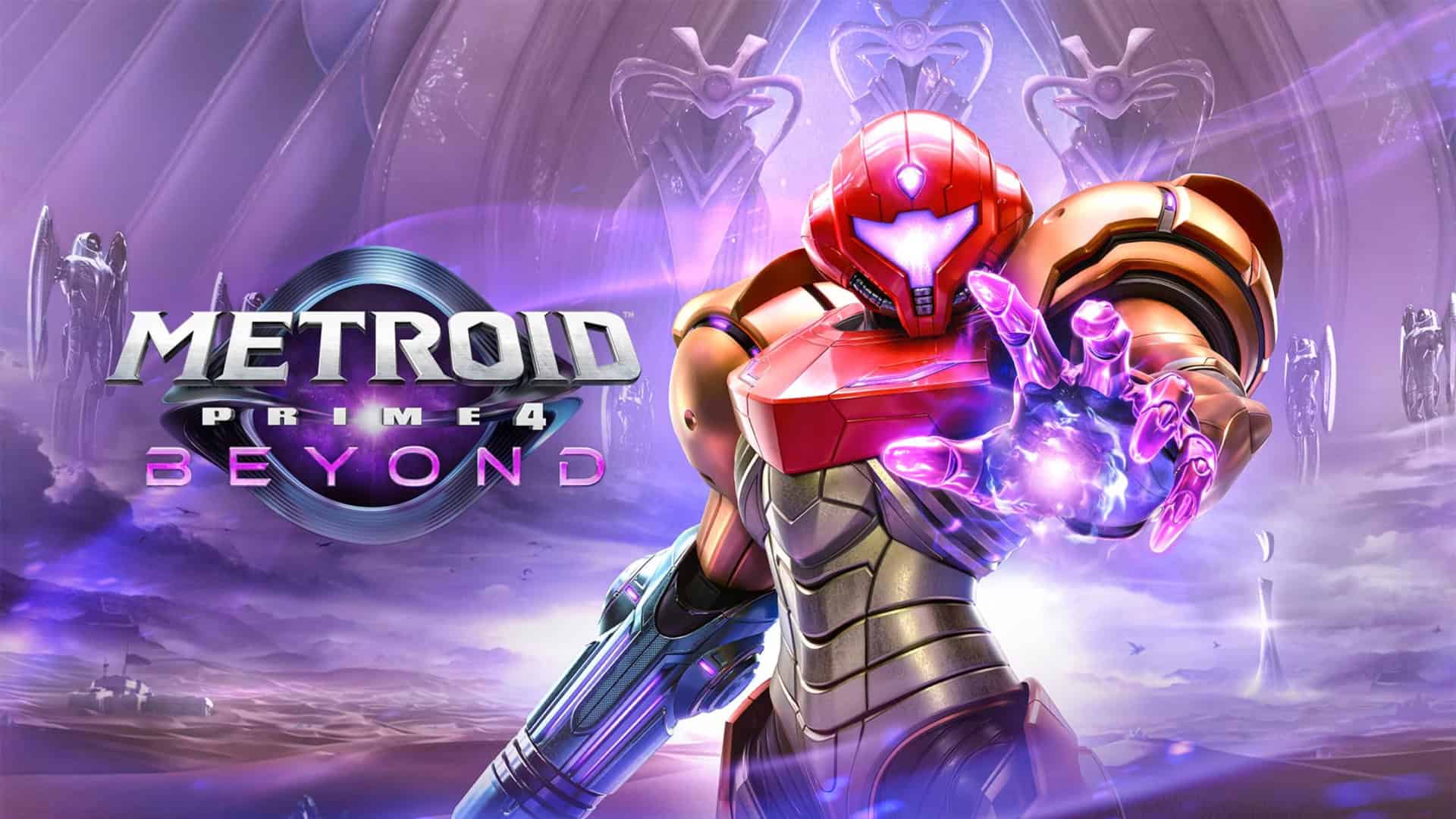
I’ve been playing Metroid since I was a small child, shortly after the first game came out. I’ve played every game in the series, including Metroid: Other M, Metroid Prime: Federation Force and both the official and fan-made remakes of Metroid II: Return of Samus. So I was looking forward to Metroid Prime 4: Beyond with eager anticipation. I picked it up day of release, and I’ve been playing it since. I have just finished up my second playthrough, in fact.
Beyond begins with Samus swooping in to assist a Galactic Federation under attack by space pirates being commanded by Sylux who is using a special breed of Metroid to fuse with and enhance his troops. After a short introductory sequence, that’s a soft tutorial to combat, scanning, and how Samus’ ability to aim is distinct from Metroid Prime 3: Corruption. Sylux attacks personally, trying to get access to an alien artifact that activates and sends Samus to Viewros, an ancient abandoned planet that seems to be at least a significant portion of the galaxy away if not farther. This also performs the legally mandated stripping of capabilities so you can get the game-specific fancy power ups later on, which largely fall into the realm of psychic powers bestowed by the forgotten enlightened race du jour, the Lamorn.

The basic plot of Beyond sees Samus exploring the various divided areas of Viewros, from a jungle to a refinery full of lava, so she can collect the various keys to a teleporter that will take her home and also allow the Lamorn to start again on a new planet as they all died out due to a great tragedy. These are kept safe by various guardians, all of whom are corrupted or have otherwise gone mad during their long wait. Along the way, Samus collects a motley crew of Federation soldiers who were also transported to Viewros, and whom she essentially babysits while getting her job done – not that they don’t help out, but it’s still very much the Samus Aran show.
Let’s address the elephant in the room: I liked the Federation soldiers. They weren’t obnoxious (even in the segments where you had one or two of them following you around), they contributed in combat without stealing Samus’s thunder (Samus does have to help them out and heal them if they take too much damage), and they absolutely helped move the story along while keeping Samus a silent protagonist, just like in Metroid Prime 2 and 3. Heck, the only time I got annoyed at them at all was during one particular part of the final battle, and then only in hard mode. In short, Beyond does a very good job of making you understand that Samus really cares about the soldiers and wants to help and protect them, and making you care about them, all without a single word of dialogue from Samus herself.

The Lamorn were a race with advanced technology and psychic powers. They grant Samus a psychic crystal which allows her to read their writing, interact with their technology, reveal secret psychic items only she can use, and to telekinetically manipulate certain objects and devices. As a result of the Lamorn’s psychic gift, much of Samus’s regular kit has been replaced with a “psychic” variant, though only some of them have a major distinction between them.
The power beam gets a special charge shot while in visor mode called the control beam, which all but stops time and allows you to guide the beam like an RC plane, with an upgrade increasing its range and allowing it to travel faster to its target. Its use is also required multiple times in puzzles and combat, up through the final boss of the game. The other series regular with a whole new use is the morph ball bomb, which can now be set to float in the air and grabbed while Samus is using the psychic visor, allowing her to throw them into otherwise unreachable bomb slots. This can also be done with power bombs when they are finally acquired, though there’s only one spot I think that trick is actually required. Metroid Prime series staples like the space jump, grapple tether, and boost ball also make their return with slight upgrades. For example, the grapple beam can be used in morph ball mode to interact with specific nodes, and certain grapple points allow Samus to hang from the wall. The integrated jump ball has also made a return, though for some reason it’s been mapped to a different button than standard jump by default. Fortunately all the controls are remappable, so you can set Samus up how you like.

The other major upgrade lines are the elemental shots, reminiscent of Metroid Prime 2’s light and dark ammo. Coming in hot, cold and electric this time, these offer better combat options against certain enemy types, unlock doors, and interact with environmental hazards and puzzles. These can also be upgraded by exploring Lamorn ruins and solving puzzles, each one getting two chargeable upgrades, like the ice spreader, or the electric beam that arcs to nearby foes, reminiscent of Metroid Prime 1’s wavebuster charge combo.
Also granted to Samus is the Vi-O-La a furuistic motorcycle that looks cool, is very fun to drive around in, and yet still felt slightly underused despite getting it being the focus of an early game section and being required in two others. I think it only having a single proper boss battle is the problem. Perhaps adding a motocycle chase with Sylux would have helped Vi-O-La stand out a bit more and kept Sylux more in the forefront.

And that brings me to my biggest complaint about Beyond, which is that Sylux, for all he was hyped up, feels fairly sidelined by the story. Not in the sense that he’s not a threat, he absolutely is, but in the sense that despite this game giving us a lot of extra lore about him and building him up as a continuing threat, he doesn’t get the same amount of focus as the past situation with the Lamorn and their societal collapse or the Federation soldiers, when a regular comparison between him and both of those would have served the story quite well. I am not saying these are not relevant to him, I just think the narrative would have been better served being a little more blunt about it, instead of leaving most of the revelations to the end and the biggest ones to a 100% completion run. And while he never goes away and does attack Samus on several occasions, there is a portion of the plot where Sylux just doesn’t do much of anything.
While Beyond is very much complete, I can’t help but feel there might have been something that didn’t make it into final production, as much of the game’s final plot coupons can only be found by meeting one of the soldiers at a spot in the desert, and then the final expansion is only available by finding the same soldier at another spot in the desert after reaching but refusing the point of no return.

The difficulty of the final boss also feels reversed, in that the first of the three fights is by far the hardest and the next two are comparatively painless, especially in hard mode where keeping your allies alive is incredibly difficult. During one phase, the boss pulls out an AOE attack that will hit several of your allies at once and if any of them are in critical state for too long or take too much damage in that state they will die and you will get a game over. I only learned this was possible when I was doing that specific fight in hard mode.
Overall, I loved Metroid Prime 4: Beyond. I played it twice in rapid succession. While the ending frustrated me, I also think it was intended. But it better have a pay off in Metroid Prime 5, and also not take the better part of 20 years to release. If you liked the previous Metroid Prime games, you’ll like what Beyond has on offer, despite its rough edges.
Tim reviewed Metroid Prime 4: Beyond on Switch 2 with his own purchased copy. This review is based on the version of the game available at the time of writing and our score will not be changed.
- Score
- 9/10 Outstanding - Tim Reccomends
- Summary
-
While Metroid Prime 4: Beyond's ending is so wide open for a sequel it will frustrate some, the rest of the game is extremely enjoyable. But it lacks polish in just enough places to ding it away from a perfect score.
- More
- GameObserver's Review Policy