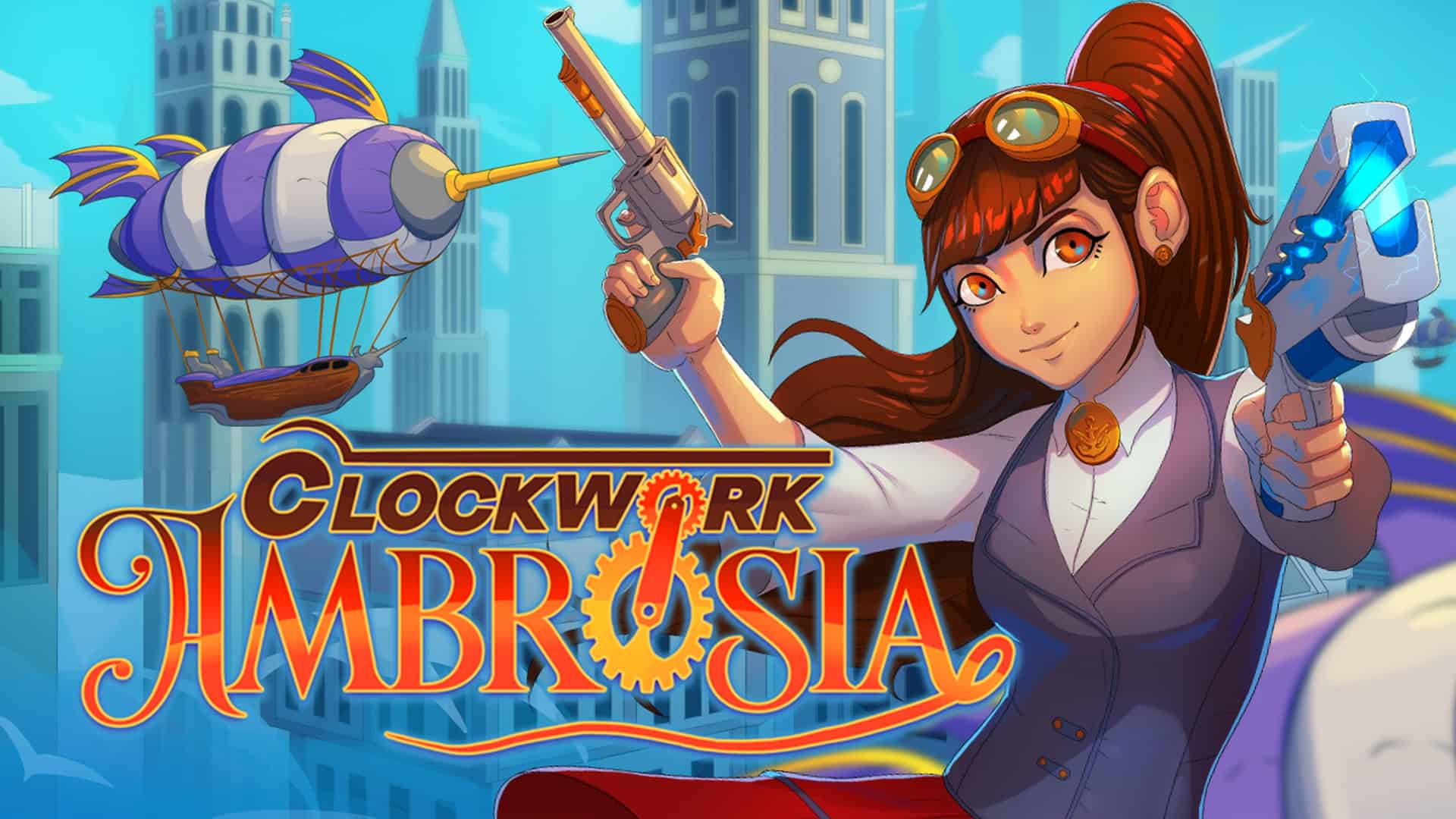
Iris is an engineer flying her personal dirigible to a long awaited vacation when a mechanical dragon appears and shoots her ship out of the air. The day goes from bad to worse when she learns the island she’s landed on has been overrun with killer robots. The local flora and fauna are pretty aggressive as well and most of the local population has gone missing. What was supposed to be her vacation is now a fight for escape and survival that takes her to the highest peaks and the deepest caves of the island, and everywhere in between. Clockwork Ambrosia by Realmsoft and OI Games is a retro-styled pixel art Metroidvania that leans more into the Metroid inspiration than most others of the genre, by which I mean Iris uses exclusively ranged weapons like guns, rockets, and grenades to fight, in contrast to the Belmonts, Shantae, Silk etc. who use melee weapons with the occasional thrown item.
Iris is also fairly unique in the way she powers up in the game. While Iris naturally gets the bevy of movement tools you’d expect from a Metroidvania hero, what she doesn’t get is much in the way of permanent power ups. Iris starts the game with three pips of health and a pip of armor, and while there are a few permanent upgrades to add a couple pips of health, the real way to add more of either health or armor comes from her equipment slots. To start, Iris can equip one item to her head, shirt, skirt, arm and leg each, and by the end of the game (assuming you’ve been finding and buying the options) can equip two of each kind. Iris has tons of equipment to add additional armor, or health, to gather items from further away, and to increase enemy drop rates. So much of it is good, especially once you upgrade it. Every piece of armor in the game can be upgraded, provided you can find the items you need in chests out in the world or from enemy drops.
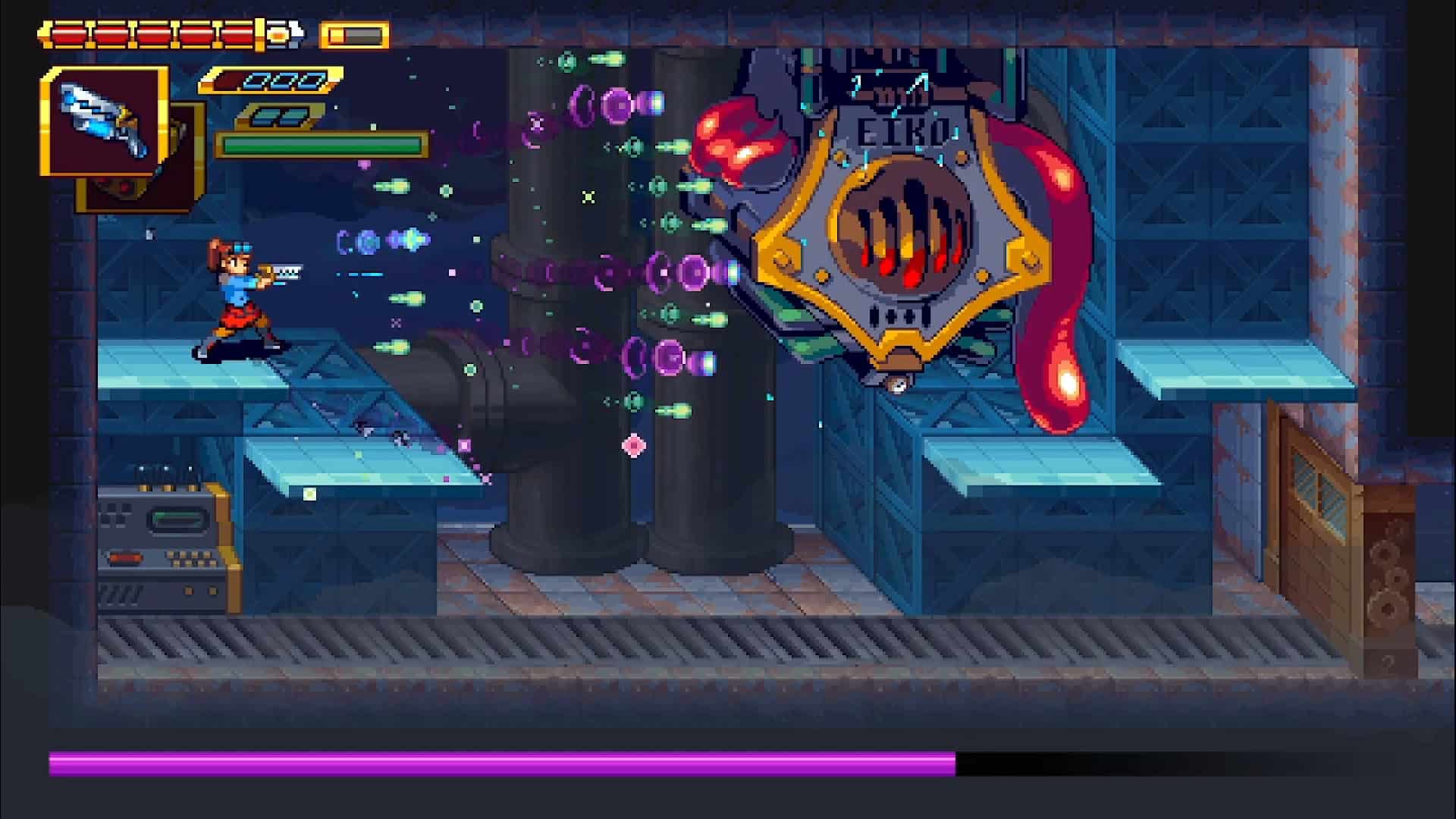
Another fairly unique function for Clockwork Ambrosia is that you cannot heal yourself outside of save points, but you can mend your armor by using energy dropped by defeated enemies – making armor more important to build than health, unless you find the piece of equipment that changes mending to restore health instead. There are so many options for armor to fit your current situation, so it’s a good idea to mix and match, especially once you unlock the extra equipment slots. As a bonus, Iris’ sprite changes to reflect the shirt and skirt equipment you currently have equipped, which is a nice touch.
The way Iris powers up is also quite novel. Over the course of Clockwork Ambrosia Iris gets four weapons. You can have two of them equipped at a time, though you can switch out which two even in the middle of battle. The four types of weapon she gets are an energy gun that has Mega Man-style charge shots, a rocket launcher, a revolver that can ricochet, and a grenade launcher you can make fire all sorts of unusual projectiles. You only ever get these four guns throughout the entire story; there are no upgraded forms with more damage or additional projectiles that obsolete an earlier version. Instead, you get modifiers that increase the damage of a shot, add projectiles and extra rounds and a whole host of other strange functions. Your gun can go from firing a single shot to firing four massive fireballs that each break into two smaller fireballs that tear through enemies, and then break into two smaller fireballs each. Your rocket launch can go from firing a single rocket per press to firing dozens.

While many of these mods can be purchased by trading scrap or items with various NPCs you meet and rescue, many of the best ones can only be found in out of the way corners of the map, encouraging you to explore every nook, cranny and corner of the sky for the purple chests that contain them, and for additional weapon modification slots for additional versatility. There are over 100 weapon mods that interact in wild and unique ways, with thousands of possible combinations, encouraging mixing and matching to find one that best suits your play style. You can also save up to three modification loadouts per weapon, so you can easily go back to your favorite setup for exploring after making changes to defeat a boss. Boss fights all felt unique and challenging without being unfair. One of the toughest was an enemy boss fight that seemed to have access to the same style of weapons as Iris did.
The game is exceptionally well designed for subtly guiding you where you need to go based on the abilities you have, while still rewarding deviating from that path to find new equipment. Once defeated, enemies stay defeated for a few screens before being reloaded. If you die, you can either reload from your last save point, or for up to three times you can choose to reload from the last room you entered. These extra lives are reset every time you use a save point, so don’t be shy about using them as you aren’t penalized for it at all. The decision to make underwater exploration based on swimming rather than slowed platforming like many other Metroidvanias also made for an original and enjoyable moment. Similarily, the movement upgrades are also fun and unique, like the ability to cling to ceilings.

In terms of feel and aesthetics, Clockwork Ambrosia is excellent. The NPCs all have unique looks and personalities, like Thalia, the miner who keeps rushing in to rescue Iris after seeing her endangered, only to arrive at the scene just moments after Iris has managed to extricate herself, or the more than slightly mad noble who sits alone in an abandoned city, exulting over the fact that he is now in charge. Enemy variety is excellent, and while there are a few palette swap foes to indicate they are tougher, there are also a wide variety of unique designs among the wild animals, insects, fish, and robots that Iris has to fight to survive on the island. The music is also incredible, setting the mood for each of the game’s areas without being too over-present.
Clockwork Ambrosia takes around 15 to 20 hours to beat, and a little more to 100%. The story is excellent, and told both out in the world and by talking with NPCs in Borestown, the general hub where most of the game’s NPCs wind up residing. I had an amazing time with Clockwork Ambrosia, and I think the modification system was a stroke of genius. I look forward to seeing what the developers have in store next.
Tim reviewed Clockwork Ambrosia on PC with a provided review code. This review is based on the version of the game available at the time of writing and our score will not be changed.
- Score
- 9/10 Outstanding - GameObserver Recommends
- Summary
-
Tim says: With an engaging story, fun level design, and more mods than you can shake a stick at, Clockwork Ambrosia is absolutely doing something unique in the Metroidvania market that everyone should be checking out.
- More
- GameObserver's Review Policy